3 Employee Ownership Events on December 4th
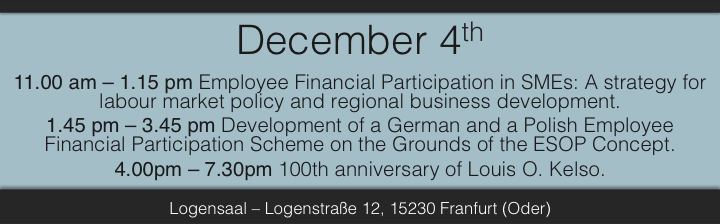
Following up on our Kelso event announcement of November 18th, we are happy to announce two further events both taking place in Frankfurt (Oder) on December 4th.
Please confirm your attendance at kelso-professorship@europa-uni.de
11.00 am – 1.15 pm Employee Financial Participation in SMEs: A strategy for labour market policy and regional business development.
The project began in October 2012 and emphasised the support and transnational exchange of knowledge and experience in shaping the future of labour policy of- Brandenburg. In the framework of the project, players from Germany, Poland and Spain came to reciprocally learn about the different forms of employee financial participation. This knowledge and Read More…

100th Anniversary of Kelso
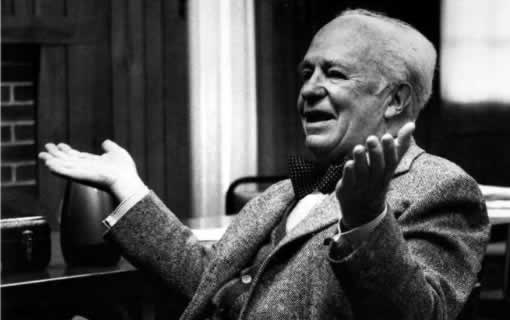
On the fourth of December we celebrate the 100th anniversary of Louis O. Kelso with an international event at the European University Viadrina.
About Kelso: Louis O. Kelso (1913-1991) was a political economist in the classical tradition of Smith, Marx and Keynes. He was also a corporate and financial lawyer, author, lecturer and merchant banker who is chiefly remembered today as the inventor and pioneer of the Employee Stock Ownership Plan (ESOP), the prototype of the leveraged buy-out which Kelso invented to enable working people without savings to buy stock in their employer company and pay for it out of its future dividend yield. Source: Kelso Institute
Kelso regarded the ESOP and CSOP as pragmatic proof that his revolutionary revision of classical economic theory, and the financial techniques he derived from this new perspective, were sound and workable in the economic and business world. As a corporate and financial lawyer, and later as senior partner in the law firm he founded, Kelso well understood this world. He was further motivated by his conviction that lawyers had a special responsibility to maintain and improve society’s institutions in the light of its democratic values. He further believed that the business corporation was society’s greatest social invention and that its executives had a fiduciary responsibility to exercise its vast power.
The event will be under the auspices of the Polish Vice-Minister of Economics, Mrs Ilona Antoniszyn-Klik.
Special guests are: Patricia Kelso (Kelso Institute), John D. Menke (Menke Group), Paul Maillard (FONDACT), David Morris (Global Wealth Allocation), Daniel Dahm (United Sustainability), Herwig Roggemann (Institute for East European Studies).
The Event is jointly organized by: The Centre for Interdisciplinary Polish Studies (Prof. Dr. Dagmara Jajeśniak-Quast) and the Kelso Professorship of Comparative Law, East-European Business Law and European Legal Policy (Prof. Dr. Jens Lowitzsch)
Time & Location: Wednesday December 4th 2013 4PM: Logensaal – Logenstr. 12,15230 Frankfurt (Oder) Germany.
Reasons for Introducing EFP – Improving Working and Living Conditions of Employees
‘To stick to wages alone is to maintain a permanent class struggle,’ said Charles de Gaulle. Building ownership of productive assets into a nation’s own working families makes good freemarketsense. The financial crisis engulfing our world is, at bottom, a consumption crisis. It is brought on by too little money in the pockets of those who are eager to buy the goods and services merchants are eager to sell and producers to supply. Once investment capital had to be painfully hoarded from savings squeezed from current consumption. EFP schemes are often seen as one solution to the above mentioned problems of industrial societies and Read More…