#ESOaction14 Conference Summary
The conference “Taking Action: Promotion of Employee Share Ownership” on Thursday 30 Jan 2014 in Brussels gathered high level representatives of all relevant stakeholders in EU policy-making to discuss options to promote Employee Share Ownership (ESO) in Europe. In line with the Commission’s initiative as well as the European Parliament’s resolution of 15 January 2014, the following five priorities broadly shared by the participants can be summarised from the discussions:
1. Establishing a Legal Framework on ESO
We should work to create an optional legal framework at the EU level that in particular would fa-cilitate cross-border ESO schemes. An EU framework is needed to establish a level playing field that would especially create opportunities for SMEs which are most affected by the consequences of the financial crisis. SMEs should receive more policy support, in particular considering the signifi-cant unexploited potential for ESO. In this context establishing a so-called 29th regime on Employee Financial Participation (EFP) appears a promising option. Hence, it seems justified that the Pilot Project should include a preliminary impact assessment of such a regime.
2. Promoting the exchange of best practice
In order to establish a functioning exchange of best practice, systematic processing and editing of information is very important. Rather than producing “another study for the shelf”, we should look into the creation of one-stop shops. A “Virtual Centre for EFP” (as presented during the confer-ence) could be a first step in that direction.
3. Providing transparency with regard to fiscal treatment and tax incentives
Tax incentives are not a prerequisite for successful implementation of ESO, but they do effectively promote such schemes. Therefore, while harmonisation is not a condition, transparency with re-gard to the different national fiscal treatment of ESO is key. In particular, an Effective Tax Rate Cal-culator (as presented during the conference) could provide a useful decision-making tool for com-panies with cross-border activities that plan to introduce EFP schemes.
4. Combining economic and labour market policies and reducing inequality
ESO fits logically into the EU’s multi-dimensional approach of combing economic and labour mar-ket policies. ESO schemes may help to create and secure jobs, reactivate unemployed and facilitate business succession in SMEs. In order to establish equality of arms, we should develop recommen-dations at EU level for fiscal and other incentives for SMEs interested in implementing ESO schemes. In this respect, investigating and promoting the transferability of best practice ESO schemes like the Sociedades Laborales and Employee Stock Ownership Plans (ESOPs) is important.
5. Incorporating ESO into Corporate Governance and Long-Term Investment strategies
Turning workers into shareholders of their employer company helps to improve corporate govern-ance by promoting transparency, sustainability and responsibility in corporate decision-making, which is one of the main objectives of the EU’s corporate governance policy. Therefore, integrating ESO into this policy should be strongly considered. Further, as ESO can foster growth of SMEs and facilitate business succession, financing ESO schemes should become one of the objectives of the Commission’s Long-Term Investment strategy. In particular it should be considered to integrate ESO in the EIB products for SME financing and incorporate ESO into the Commission’s proposal for the regulation on European Long-Term Investment Funds (ELTIFs).
In order to achieve these aims, social partners and all other relevant stakeholders should be closely involved in the process. Further, any promotion of ESO should respect the relevant fundamental princi-ples as identified by the 1992 Commission Recommendation on EFP and reiterated in the EP Own-Initiative Report of 15 January 2014. After many years of research and fruitful discussion the time has come for concrete actions: Let’s make ESO a positive priority in Europe!
all conference materials are available for download via our Intercentar Website
conference pictures can be found on Facebook

The Employee Stock Ownership Trust – A New Trend In Employee Benefits and Corporate Finance
Article by: John D. Menke http://www.menke.com
An increasing number of companies are turning to Employee Stock Ownership Trust financing as a means to simultaneously raise low cost capital and provide increased employee incentives and retirement benefits while reducing the cost of qualified plan benefits. The Employee Stock Ownership Plan is a qualified plan under Section 401(a) of the Internal Revenue Code. As such it is in the same family as pension plans, profit sharing plans and stock bonus plans. Nevertheless, The Employee Stock Ownership Plan (which together with the Employee Stock Ownership Plan, is referred to as the “Trust” or “ESOP”) is qualitatively different from other types of “qualified plans,” both in its concept and in its applications.
Because of its inherent flexibility, because of its ability to facilitate and enhance corporate growth and because of its separate status under the recently enacted Pension Reform Act, Read More…
European Parliament adopted report on Employee Financial Participation
The year is only two weeks old and Employee Ownership is already a positively discussed topic in the EU Parliament. Today (14/01/2014), the European Parliament adopted, with an amazing 562 positive to 62 negative votes, an own-initiative report 2013/2127(INI), that treats financial participation of employees in companies’ proceeds.

EFP on the EU policy agenda
Several recent EU reports have highlighted the potential benefits and advantages of employee financial participation (EFP). Over the past 30 years a large number of empirical studies have corroborated these findings. The latest round of EU cross-country studies (EWCS, CRANET, ECS) note that employees continue to expand their participation in ESO plans in Europe despite the financial crisis.
Best Practice Case Study: Voestalpine, Austria
For our 2012 EU Parliament study on Employee participation in the European Union, we published best practice case studies on both companies and countries. Here you find the full version of our best practice case study on Voestalpine, one of the worlds largest steel producers. Voestalpine became partially owned by its employees after the privatization in the year 2000. -we would be happy to hear your thoughts on this case study.
Introduction
Voestalpine AG—headquartered in Linz (Austria)—is mainly active in the production and treatment of steel. As a successful international corporate group with some 300 production and sales companies in more than 60 countries, it has nearly 40,000 employees (fewer than half of them in Austria). In conjunction with discussions about the full privatisation of the corporate group undertaken at the beginning of 2000, the group’s Board of Management together with the employee representatives developed and later implemented an employee participation scheme, which at that time was unprecedented in Austria. Through this, a large portion of the group’s workforce as well as a small group of ex-employees currently hold a 13.3 per cent stake (around 22 million shares) administrated by a private foundation (Voestalpine Mitarbeiterbeteiligung Privatstiftung).
The man who created 10 Million capitalists: Louis O. Kelso
He believed in the Promethean power of man. He wrote “The Capitalist Manifest” even though he did not like the title chosen by the editor. He created facts where others just talked about utopia. At the occasion of his 100st birthday on 4th December 2013 his widow and friends remembered the American lawyer and investment banker, who revolutionised classical economic theory. Kelso’s ideas and their implementation offer solutions for current societal problems – especially today.
CONFERENCE Taking Action: Debating concrete policy options to promote ESO
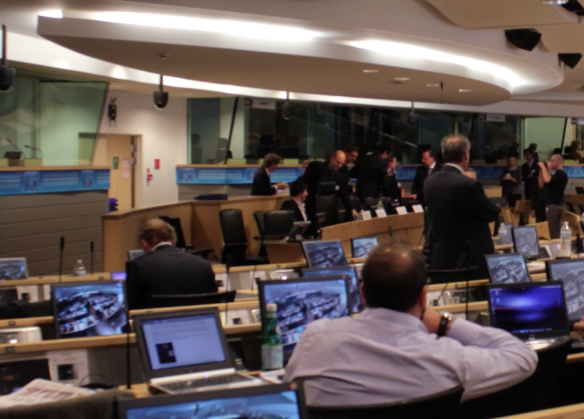
In the context of the European Commission Action Plan on Corporate Governance a conference will debate concrete policy options to promote Employee Share Ownership (ESO), in particular in its cross-border dimension. The full-day event will present examples of best practices from different countries. Participants will be provided with the opportunity to discuss the interim results of the EU pilot project Promotion of Employee Ownership and Participation that will be presented at this occasion.
Michel Barnier, EU Commissioner for Internal Market and Services, opens the conference which is jointly organised by DG Internal Market and Services, Europa-Universität Viadrina and Freie Universität Berlin (Inter-University Centre).
Conference
Taking Action: Promotion of Employee Share Ownership – Debating concrete policy options in the context of the EC Action Plan on Corporate Governance
When?
30.01.2014 from 8:30 to 16:30.
Where?
Albert Borschette Congress Centre, Rue Froissart 36, Brussels, Belgium

Video “Men and Jobs” by The Economist
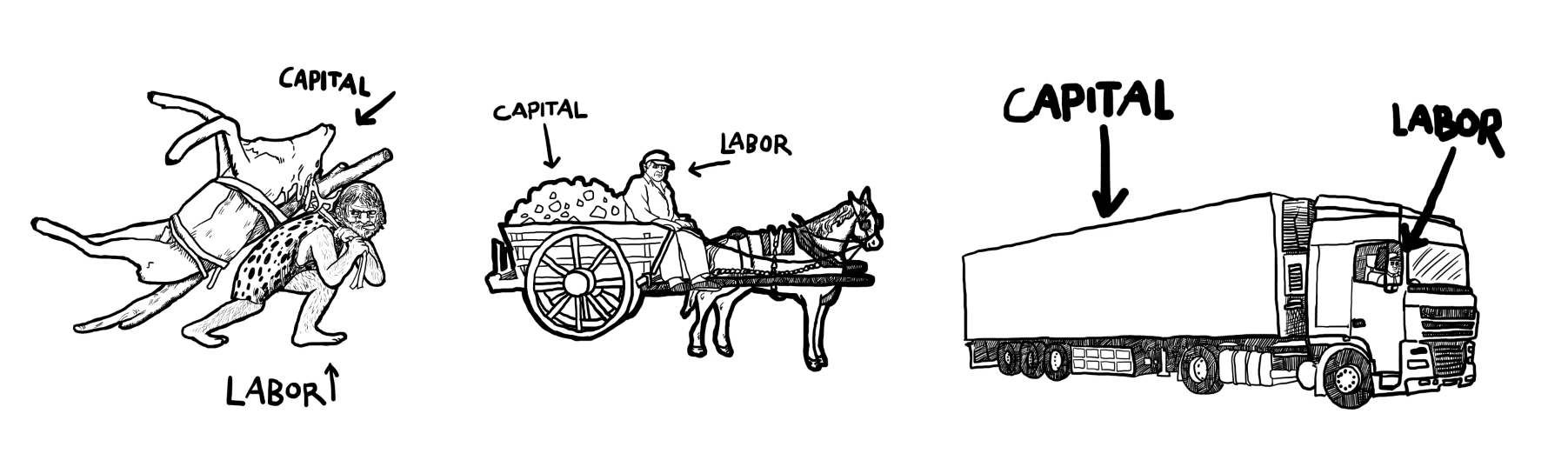
We found this interesting video on the contribution of capital and labor to work. Ryan Avent describes here that the share of capital is increasing while the share of labor is simultaneously decreasing. This decreasing share of labour was already observed by Louis O. Kelso, he claimed that employee ownership is a great tool that lets labour participate in the outcomes of productive capital via ownership. Ryan Avent from The Economist (Video below) seems to have the same thoughts as he says that employee ownership might function as one of the solutions by having ownership in the productive capital.
The best way to make this capital ownership available to all employees is by means of a leveraged ESOP model. The leveraged ESOP model allows the company to take on a bank loan in order to provide employees with shares of the company, by using the trust as the vehicle of holding shares. The leveraged effect originates from the loan repayment by future earnings.
[youtube=http://www.youtube.com/watch?v=BLqN8mj17hU&w=560&h=315]
Also see our previous blog posts:
The Economist: A shirnking slice – Labours’ share of national income has fallen
197 Words intro on leveraged ESOPs
Follow us on twitter @ProEFP or connect via Facebook.com/intercentar
Selected Article: A Shrinking Slice – Labour’s Share of National Income Has Fallen

“Imagine the proceeds of economic output as a pie, crudely divided between the wages earned by workers and the returns accrued to the owners of capital.” With this picture in mind, The Economist proves with numbers that “the workers’ take from the pie has shrunk across the globe” over the past 30 years. Especially “when growth is sluggish, as it is now, most workers are getting a smaller morsel of a smaller slice of a slow-growing pie“.
So what can be done? The Economist states that the goal should be to strengthen workers without hamstringing firms. In fact, “a good antidote to labour’s falling share of national income would be to boost ordinary workers’ share of capital.”