European Parliament adopted report on Employee Financial Participation
The year is only two weeks old and Employee Ownership is already a positively discussed topic in the EU Parliament. Today (14/01/2014), the European Parliament adopted, with an amazing 562 positive to 62 negative votes, an own-initiative report 2013/2127(INI), that treats financial participation of employees in companies’ proceeds.

EFP on the EU policy agenda
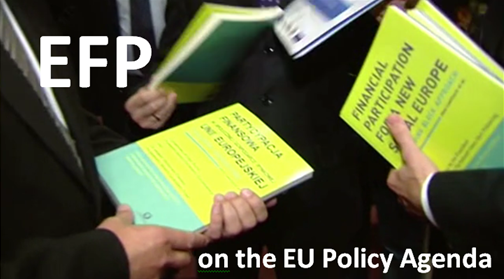
Several recent EU reports have highlighted the potential benefits and advantages of employee financial participation (EFP). Over the past 30 years a large number of empirical studies have corroborated these findings. The latest round of EU cross-country studies (EWCS, CRANET, ECS) note that employees continue to expand their participation in ESO plans in Europe despite the financial crisis.
The man who created 10 Million capitalists: Louis O. Kelso
He believed in the Promethean power of man. He wrote “The Capitalist Manifest” even though he did not like the title chosen by the editor. He created facts where others just talked about utopia. At the occasion of his 100st birthday on 4th December 2013 his widow and friends remembered the American lawyer and investment banker, who revolutionised classical economic theory. Kelso’s ideas and their implementation offer solutions for current societal problems – especially today.
CONFERENCE Taking Action: Debating concrete policy options to promote ESO

In the context of the European Commission Action Plan on Corporate Governance a conference will debate concrete policy options to promote Employee Share Ownership (ESO), in particular in its cross-border dimension. The full-day event will present examples of best practices from different countries. Participants will be provided with the opportunity to discuss the interim results of the EU pilot project Promotion of Employee Ownership and Participation that will be presented at this occasion.
Michel Barnier, EU Commissioner for Internal Market and Services, opens the conference which is jointly organised by DG Internal Market and Services, Europa-Universität Viadrina and Freie Universität Berlin (Inter-University Centre).
Conference
Taking Action: Promotion of Employee Share Ownership – Debating concrete policy options in the context of the EC Action Plan on Corporate Governance
When?
30.01.2014 from 8:30 to 16:30.
Where?
Albert Borschette Congress Centre, Rue Froissart 36, Brussels, Belgium

Video “Men and Jobs” by The Economist
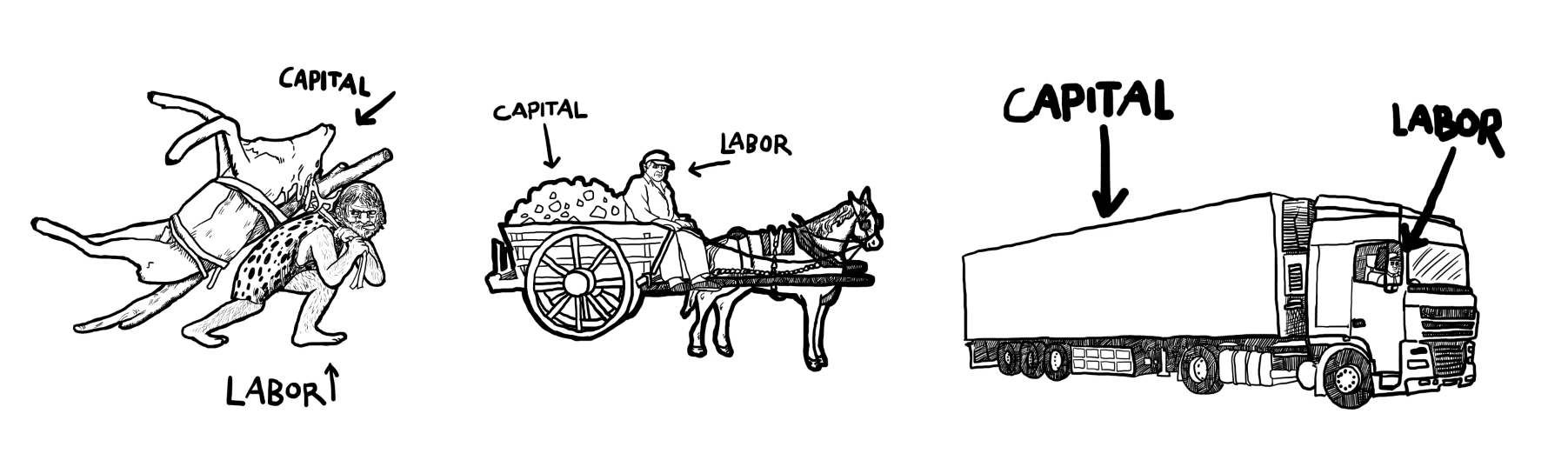
We found this interesting video on the contribution of capital and labor to work. Ryan Avent describes here that the share of capital is increasing while the share of labor is simultaneously decreasing. This decreasing share of labour was already observed by Louis O. Kelso, he claimed that employee ownership is a great tool that lets labour participate in the outcomes of productive capital via ownership. Ryan Avent from The Economist (Video below) seems to have the same thoughts as he says that employee ownership might function as one of the solutions by having ownership in the productive capital.
The best way to make this capital ownership available to all employees is by means of a leveraged ESOP model. The leveraged ESOP model allows the company to take on a bank loan in order to provide employees with shares of the company, by using the trust as the vehicle of holding shares. The leveraged effect originates from the loan repayment by future earnings.
[youtube=http://www.youtube.com/watch?v=BLqN8mj17hU&w=560&h=315]
Also see our previous blog posts:
The Economist: A shirnking slice – Labours’ share of national income has fallen
197 Words intro on leveraged ESOPs
Follow us on twitter @ProEFP or connect via Facebook.com/intercentar
Selected Article: A Shrinking Slice – Labour’s Share of National Income Has Fallen

“Imagine the proceeds of economic output as a pie, crudely divided between the wages earned by workers and the returns accrued to the owners of capital.” With this picture in mind, The Economist proves with numbers that “the workers’ take from the pie has shrunk across the globe” over the past 30 years. Especially “when growth is sluggish, as it is now, most workers are getting a smaller morsel of a smaller slice of a slow-growing pie“.
So what can be done? The Economist states that the goal should be to strengthen workers without hamstringing firms. In fact, “a good antidote to labour’s falling share of national income would be to boost ordinary workers’ share of capital.”
Update: Sociedades Laborales too successful
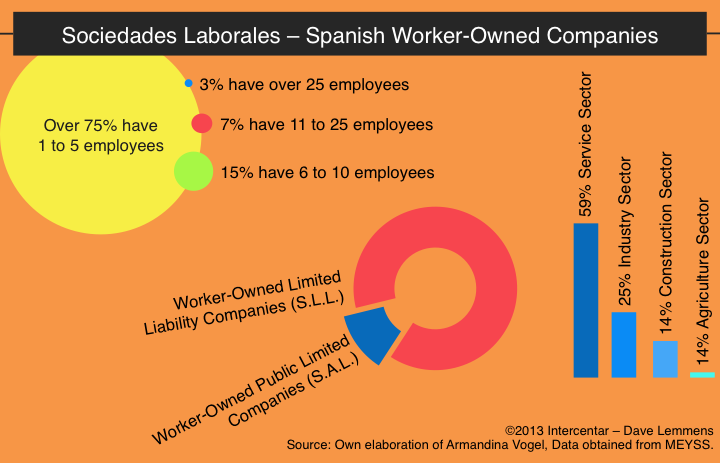
Sociedades Laborales (SL) are a specific form of corporation in Spain which is majority-owned by its permanent employees. This concept is probably the only EFP scheme existing across the EU that specifically applies to small and smallest companies. Compared to conventional firms, SLs have grown in greater numbers, yet the net increase is negative.
At the time we assumed that all disqualifications of SLs (disappearance from the registry of SL) were due to liquidation or bankruptcy and calculated the survival rate accordingly. However, it turned out that an additional reason for their disappearance was that some SLs convert into conventional companies. They continue to exist with substantial employee ownership but do no longer qualify as SL, for example, because the employee ownership rate drops below 50%.
In fact, the reason that they disqualify is often that they become “victims of their success” (as opposed to going bankrupt). From what we know now, between 1 January 2010 and 31 December 2012 in the Basque Registrar of “Sociedades Laborales” of 110 disqualifications 51 became conventional companies, i.e., 46.36% of which only 8 have closed down.
This means that the survival rate we previously calculated for SLs in Basque Country is in fact much higher. Of the 110 former “Sociedades Laborales” which were previously reported bankrupt or liquidated 39% still exist nowadays but are conventional companies still with substantial employee ownership (but less than 50%).
————–
Employee financial particiaption (EFP) in Spain largely takes the form of Sociedades Laborales (Worker-Owned Companies). This concept is probably the only EFP scheme existing across the EU that is solely applying to small and smallest companies.
The best practice character and details of this concept are widely discussed among Spanish, Polish and German institutions within the Project Employee Financial Participation in Small and Medium Enterprises – A Strategy for Labour Market Policy and Regional Business Development.
This project of the Kelso-Professorship at Europa-Universität Viadrina Frankfurt (Oder) is supported by the Ministry of Labour, Social Affairs, Women and Family Affairs of the Land of Brandenburg with funds from the European Social Fund and the Land of Brandenburg. You are invited to join the final conference on the 4th of December, during which the project partners will present the results of their experience exchange.
Find more information on Sociedades Laborales in our blog post.
Sociedades Laborales
Employee financial particiaption (EFP) in Spain largely takes the form of Sociedades Laborales (Worker-Owned Companies). This concept is probably the only EFP scheme existing across the EU that is solely applying to small and smallest companies.
The best practice character and details of this concept are widely discussed among Spanish, Polish and German institutions within the Project Employee Financial Participation in Small and Medium Enterprises – A Strategy for Labour Market Policy and Regional Business Development.
This project of the Kelso-Professorship at Europa-Universität Viadrina Frankfurt (Oder) is supported by the Ministry of Labour, Social Affairs, Women and Family Affairs of the Land of Brandenburg with funds from the European Social Fund and the Land of Brandenburg. You are invited to join the final conference on the 4th of December, during which the project partners will present the results of their experience exchange.