Best Practice Case Study: Voestalpine, Austria
For our 2012 EU Parliament study on Employee participation in the European Union, we published best practice case studies on both companies and countries. Here you find the full version of our best practice case study on Voestalpine, one of the worlds largest steel producers. Voestalpine became partially owned by its employees after the privatization in the year 2000. -we would be happy to hear your thoughts on this case study.
Introduction
Voestalpine AG—headquartered in Linz (Austria)—is mainly active in the production and treatment of steel. As a successful international corporate group with some 300 production and sales companies in more than 60 countries, it has nearly 40,000 employees (fewer than half of them in Austria). In conjunction with discussions about the full privatisation of the corporate group undertaken at the beginning of 2000, the group’s Board of Management together with the employee representatives developed and later implemented an employee participation scheme, which at that time was unprecedented in Austria. Through this, a large portion of the group’s workforce as well as a small group of ex-employees currently hold a 13.3 per cent stake (around 22 million shares) administrated by a private foundation (Voestalpine Mitarbeiterbeteiligung Privatstiftung).

Update: Sociedades Laborales too successful
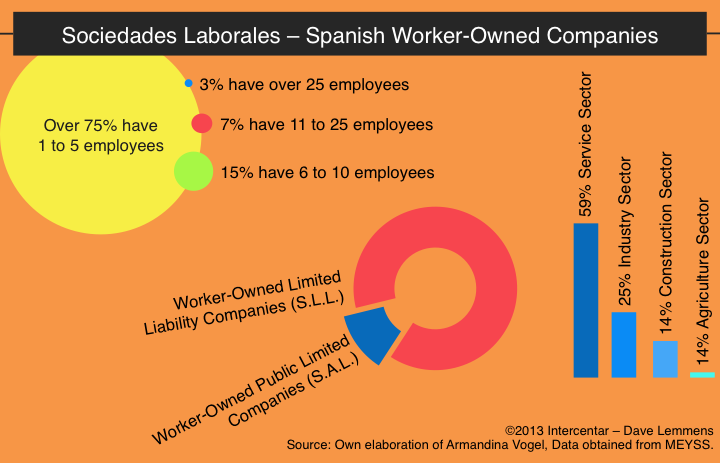
Sociedades Laborales (SL) are a specific form of corporation in Spain which is majority-owned by its permanent employees. This concept is probably the only EFP scheme existing across the EU that specifically applies to small and smallest companies. Compared to conventional firms, SLs have grown in greater numbers, yet the net increase is negative.
At the time we assumed that all disqualifications of SLs (disappearance from the registry of SL) were due to liquidation or bankruptcy and calculated the survival rate accordingly. However, it turned out that an additional reason for their disappearance was that some SLs convert into conventional companies. They continue to exist with substantial employee ownership but do no longer qualify as SL, for example, because the employee ownership rate drops below 50%.
In fact, the reason that they disqualify is often that they become “victims of their success” (as opposed to going bankrupt). From what we know now, between 1 January 2010 and 31 December 2012 in the Basque Registrar of “Sociedades Laborales” of 110 disqualifications 51 became conventional companies, i.e., 46.36% of which only 8 have closed down.
This means that the survival rate we previously calculated for SLs in Basque Country is in fact much higher. Of the 110 former “Sociedades Laborales” which were previously reported bankrupt or liquidated 39% still exist nowadays but are conventional companies still with substantial employee ownership (but less than 50%).
————–
Employee financial particiaption (EFP) in Spain largely takes the form of Sociedades Laborales (Worker-Owned Companies). This concept is probably the only EFP scheme existing across the EU that is solely applying to small and smallest companies.
The best practice character and details of this concept are widely discussed among Spanish, Polish and German institutions within the Project Employee Financial Participation in Small and Medium Enterprises – A Strategy for Labour Market Policy and Regional Business Development.
This project of the Kelso-Professorship at Europa-Universität Viadrina Frankfurt (Oder) is supported by the Ministry of Labour, Social Affairs, Women and Family Affairs of the Land of Brandenburg with funds from the European Social Fund and the Land of Brandenburg. You are invited to join the final conference on the 4th of December, during which the project partners will present the results of their experience exchange.
Find more information on Sociedades Laborales in our blog post.
Best Practice: Case Study on Childbase Ltd.
For our 2012 EU Parliament study on Employee participation in the European Union, we published best practice case studies on both companies and countries. Here you find the full version of our best practice case study on Childbase, a child care provider in the UK, that is implementing an ESOP with as a goal 100% Employee Ownership.
Introduction
Childbase Partnership Limited is a company with the headquarters in Newport Pagnell, UK, which operates a chain of nurseries throughout the United Kingdom, but mainly in the South of England. Originally, Sir Peter Thompson and his son Mike Thompson founded it as a small family company with four staff members and 20 children in 1989. Read More…
Sociedades Laborales
Employee financial particiaption (EFP) in Spain largely takes the form of Sociedades Laborales (Worker-Owned Companies). This concept is probably the only EFP scheme existing across the EU that is solely applying to small and smallest companies.
The best practice character and details of this concept are widely discussed among Spanish, Polish and German institutions within the Project Employee Financial Participation in Small and Medium Enterprises – A Strategy for Labour Market Policy and Regional Business Development.
This project of the Kelso-Professorship at Europa-Universität Viadrina Frankfurt (Oder) is supported by the Ministry of Labour, Social Affairs, Women and Family Affairs of the Land of Brandenburg with funds from the European Social Fund and the Land of Brandenburg. You are invited to join the final conference on the 4th of December, during which the project partners will present the results of their experience exchange.
Best Practice: Gore and Associates
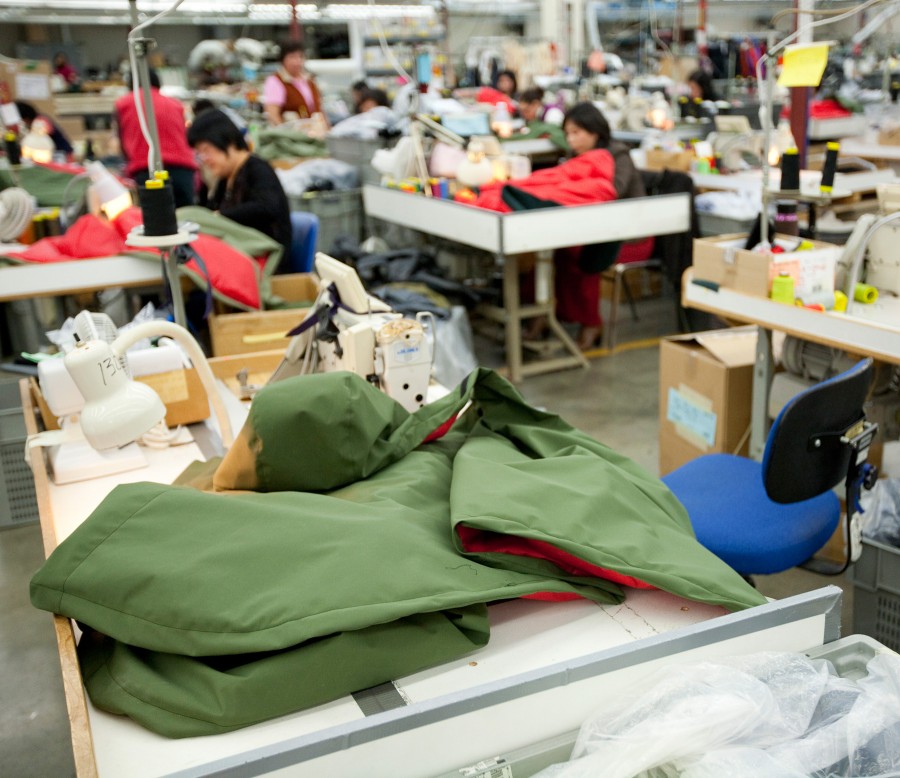
As Gore says themselves: „we have more than 10,000 employees, called associates.“
This, at a first glance, small difference in wording originates from the concept of a latice organizational culture and is in fact having a major impact on the corporate culture and performance of Gore. Every employee at Gore is indeed sharing in the corporate success via the ownership of stocks. A central element, the so-called Associate Stock Ownership Plan, allows the associates to do so. This gives Gore and its associates multiple benefits, among which:
- Opportunities to build up financial security for retirement.
- Improving performance by giving the employees the feeling of being a co-owner of the company that they work for.
Also see Forbes’ Article: Four Ways To Get Your Employees To Care Like Owners http://t.co/kZx0TVg6LZ
It is not without reason that Gore becomes well ranked in various overviews for best companies to work for. Even better, this does not only hold for the US based facilities, but also for most of their worldwide facilities.
Click here to keep reading about Gore as a best practice!