#ESOaction14 Conference Summary
The conference “Taking Action: Promotion of Employee Share Ownership” on Thursday 30 Jan 2014 in Brussels gathered high level representatives of all relevant stakeholders in EU policy-making to discuss options to promote Employee Share Ownership (ESO) in Europe. In line with the Commission’s initiative as well as the European Parliament’s resolution of 15 January 2014, the following five priorities broadly shared by the participants can be summarised from the discussions:
1. Establishing a Legal Framework on ESO
We should work to create an optional legal framework at the EU level that in particular would fa-cilitate cross-border ESO schemes. An EU framework is needed to establish a level playing field that would especially create opportunities for SMEs which are most affected by the consequences of the financial crisis. SMEs should receive more policy support, in particular considering the signifi-cant unexploited potential for ESO. In this context establishing a so-called 29th regime on Employee Financial Participation (EFP) appears a promising option. Hence, it seems justified that the Pilot Project should include a preliminary impact assessment of such a regime.
2. Promoting the exchange of best practice
In order to establish a functioning exchange of best practice, systematic processing and editing of information is very important. Rather than producing “another study for the shelf”, we should look into the creation of one-stop shops. A “Virtual Centre for EFP” (as presented during the confer-ence) could be a first step in that direction.
3. Providing transparency with regard to fiscal treatment and tax incentives
Tax incentives are not a prerequisite for successful implementation of ESO, but they do effectively promote such schemes. Therefore, while harmonisation is not a condition, transparency with re-gard to the different national fiscal treatment of ESO is key. In particular, an Effective Tax Rate Cal-culator (as presented during the conference) could provide a useful decision-making tool for com-panies with cross-border activities that plan to introduce EFP schemes.
4. Combining economic and labour market policies and reducing inequality
ESO fits logically into the EU’s multi-dimensional approach of combing economic and labour mar-ket policies. ESO schemes may help to create and secure jobs, reactivate unemployed and facilitate business succession in SMEs. In order to establish equality of arms, we should develop recommen-dations at EU level for fiscal and other incentives for SMEs interested in implementing ESO schemes. In this respect, investigating and promoting the transferability of best practice ESO schemes like the Sociedades Laborales and Employee Stock Ownership Plans (ESOPs) is important.
5. Incorporating ESO into Corporate Governance and Long-Term Investment strategies
Turning workers into shareholders of their employer company helps to improve corporate govern-ance by promoting transparency, sustainability and responsibility in corporate decision-making, which is one of the main objectives of the EU’s corporate governance policy. Therefore, integrating ESO into this policy should be strongly considered. Further, as ESO can foster growth of SMEs and facilitate business succession, financing ESO schemes should become one of the objectives of the Commission’s Long-Term Investment strategy. In particular it should be considered to integrate ESO in the EIB products for SME financing and incorporate ESO into the Commission’s proposal for the regulation on European Long-Term Investment Funds (ELTIFs).
In order to achieve these aims, social partners and all other relevant stakeholders should be closely involved in the process. Further, any promotion of ESO should respect the relevant fundamental princi-ples as identified by the 1992 Commission Recommendation on EFP and reiterated in the EP Own-Initiative Report of 15 January 2014. After many years of research and fruitful discussion the time has come for concrete actions: Let’s make ESO a positive priority in Europe!
all conference materials are available for download via our Intercentar Website
conference pictures can be found on Facebook

Best Practice Case Study: Voestalpine, Austria
For our 2012 EU Parliament study on Employee participation in the European Union, we published best practice case studies on both companies and countries. Here you find the full version of our best practice case study on Voestalpine, one of the worlds largest steel producers. Voestalpine became partially owned by its employees after the privatization in the year 2000. -we would be happy to hear your thoughts on this case study.
Introduction
Voestalpine AG—headquartered in Linz (Austria)—is mainly active in the production and treatment of steel. As a successful international corporate group with some 300 production and sales companies in more than 60 countries, it has nearly 40,000 employees (fewer than half of them in Austria). In conjunction with discussions about the full privatisation of the corporate group undertaken at the beginning of 2000, the group’s Board of Management together with the employee representatives developed and later implemented an employee participation scheme, which at that time was unprecedented in Austria. Through this, a large portion of the group’s workforce as well as a small group of ex-employees currently hold a 13.3 per cent stake (around 22 million shares) administrated by a private foundation (Voestalpine Mitarbeiterbeteiligung Privatstiftung).
3 Employee Ownership Events on December 4th
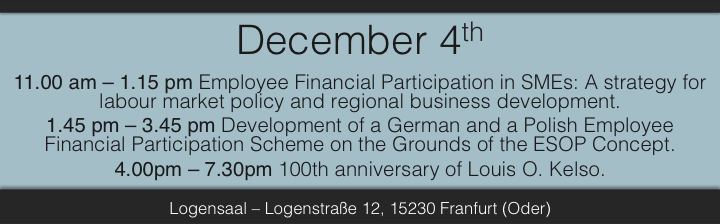
Following up on our Kelso event announcement of November 18th, we are happy to announce two further events both taking place in Frankfurt (Oder) on December 4th.
Please confirm your attendance at kelso-professorship@europa-uni.de
11.00 am – 1.15 pm Employee Financial Participation in SMEs: A strategy for labour market policy and regional business development.
The project began in October 2012 and emphasised the support and transnational exchange of knowledge and experience in shaping the future of labour policy of- Brandenburg. In the framework of the project, players from Germany, Poland and Spain came to reciprocally learn about the different forms of employee financial participation. This knowledge and Read More…
Selected Articles: Why more employee ownership is needed! (from: US News)
We found this interesting US News article on why more employee owned businesses are needed. The article is perfectly describing the similarities and differences between employee and non-employee owned companies.
David Brodwin, the author, points out that: “A truly sustainable economy needs more employee-owned businesses and partnerships.”
He also makes an important point by claiming that: “These businesses stabilize consumer incomes and spending power, stabilize employment, stabilize corporate cash flows, and blunt the extremes of the business cycle. For this to happen we’ll need to find ways to attract more capital into the field, to finance the conversion of existing investor-owned businesses to a new ownership model.”
The challenge for Financial Participation in businesses
The issue of employees participating in the financial results of their company has become an important political issue across the European Union. It is seen as a mean of promoting greater co-operation between management, owners and employees, eventually leading to a reduction in workplace conflict and, Read More…
Desperation or taking a chance in the Greece crisis?
Greece is saved. The latest rescue package of 12 Billion Euros from the European Partners and the International Monetary Fund stabilises Greece’s and Europe’s financial markets and the euro-zone. At least for the moment . Seen from outside of the ever more indebted Hellenic country one might say that the decision of the socialist majority of the Greek parliamentarians from Wednesday 29 June 2011 was a rational and good decision for the Greek people. If only the desperate violent acts of the Greek population around the Hellenic Parliament and the Syntagma square would not exist. Their desperate behaviour demonstrate a slightly different attitude. The agglomerated violence, the aggressive Read More…