Selected Article: A Shrinking Slice – Labour’s Share of National Income Has Fallen

“Imagine the proceeds of economic output as a pie, crudely divided between the wages earned by workers and the returns accrued to the owners of capital.” With this picture in mind, The Economist proves with numbers that “the workers’ take from the pie has shrunk across the globe” over the past 30 years. Especially “when growth is sluggish, as it is now, most workers are getting a smaller morsel of a smaller slice of a slow-growing pie“.
So what can be done? The Economist states that the goal should be to strengthen workers without hamstringing firms. In fact, “a good antidote to labour’s falling share of national income would be to boost ordinary workers’ share of capital.”

3 Employee Ownership Events on December 4th
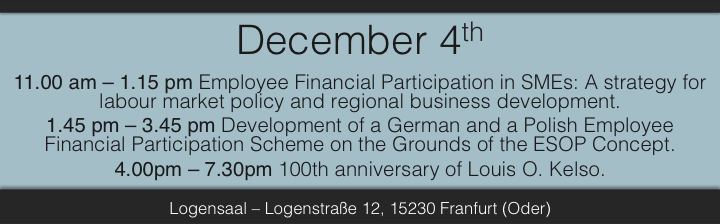
Following up on our Kelso event announcement of November 18th, we are happy to announce two further events both taking place in Frankfurt (Oder) on December 4th.
Please confirm your attendance at kelso-professorship@europa-uni.de
11.00 am – 1.15 pm Employee Financial Participation in SMEs: A strategy for labour market policy and regional business development.
The project began in October 2012 and emphasised the support and transnational exchange of knowledge and experience in shaping the future of labour policy of- Brandenburg. In the framework of the project, players from Germany, Poland and Spain came to reciprocally learn about the different forms of employee financial participation. This knowledge and Read More…
Update: Sociedades Laborales too successful
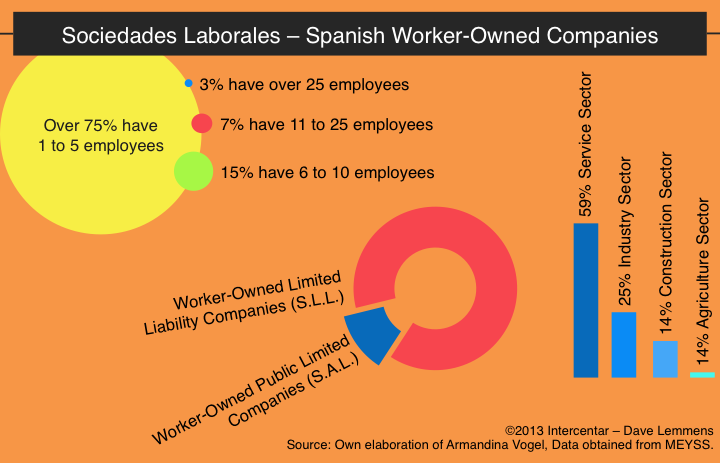
Sociedades Laborales (SL) are a specific form of corporation in Spain which is majority-owned by its permanent employees. This concept is probably the only EFP scheme existing across the EU that specifically applies to small and smallest companies. Compared to conventional firms, SLs have grown in greater numbers, yet the net increase is negative.
At the time we assumed that all disqualifications of SLs (disappearance from the registry of SL) were due to liquidation or bankruptcy and calculated the survival rate accordingly. However, it turned out that an additional reason for their disappearance was that some SLs convert into conventional companies. They continue to exist with substantial employee ownership but do no longer qualify as SL, for example, because the employee ownership rate drops below 50%.
In fact, the reason that they disqualify is often that they become “victims of their success” (as opposed to going bankrupt). From what we know now, between 1 January 2010 and 31 December 2012 in the Basque Registrar of “Sociedades Laborales” of 110 disqualifications 51 became conventional companies, i.e., 46.36% of which only 8 have closed down.
This means that the survival rate we previously calculated for SLs in Basque Country is in fact much higher. Of the 110 former “Sociedades Laborales” which were previously reported bankrupt or liquidated 39% still exist nowadays but are conventional companies still with substantial employee ownership (but less than 50%).
————–
Employee financial particiaption (EFP) in Spain largely takes the form of Sociedades Laborales (Worker-Owned Companies). This concept is probably the only EFP scheme existing across the EU that is solely applying to small and smallest companies.
The best practice character and details of this concept are widely discussed among Spanish, Polish and German institutions within the Project Employee Financial Participation in Small and Medium Enterprises – A Strategy for Labour Market Policy and Regional Business Development.
This project of the Kelso-Professorship at Europa-Universität Viadrina Frankfurt (Oder) is supported by the Ministry of Labour, Social Affairs, Women and Family Affairs of the Land of Brandenburg with funds from the European Social Fund and the Land of Brandenburg. You are invited to join the final conference on the 4th of December, during which the project partners will present the results of their experience exchange.
Find more information on Sociedades Laborales in our blog post.
Best Practice: Case Study on Childbase Ltd.
For our 2012 EU Parliament study on Employee participation in the European Union, we published best practice case studies on both companies and countries. Here you find the full version of our best practice case study on Childbase, a child care provider in the UK, that is implementing an ESOP with as a goal 100% Employee Ownership.
Introduction
Childbase Partnership Limited is a company with the headquarters in Newport Pagnell, UK, which operates a chain of nurseries throughout the United Kingdom, but mainly in the South of England. Originally, Sir Peter Thompson and his son Mike Thompson founded it as a small family company with four staff members and 20 children in 1989. Read More…
Sociedades Laborales
Employee financial particiaption (EFP) in Spain largely takes the form of Sociedades Laborales (Worker-Owned Companies). This concept is probably the only EFP scheme existing across the EU that is solely applying to small and smallest companies.
The best practice character and details of this concept are widely discussed among Spanish, Polish and German institutions within the Project Employee Financial Participation in Small and Medium Enterprises – A Strategy for Labour Market Policy and Regional Business Development.
This project of the Kelso-Professorship at Europa-Universität Viadrina Frankfurt (Oder) is supported by the Ministry of Labour, Social Affairs, Women and Family Affairs of the Land of Brandenburg with funds from the European Social Fund and the Land of Brandenburg. You are invited to join the final conference on the 4th of December, during which the project partners will present the results of their experience exchange.
100th Anniversary of Kelso
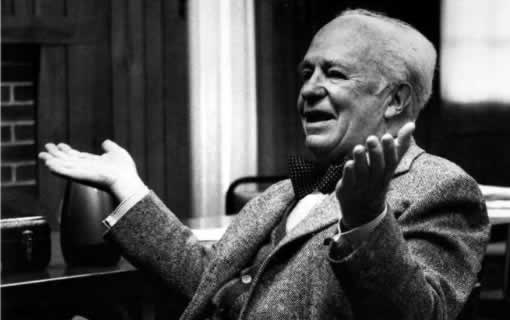
On the fourth of December we celebrate the 100th anniversary of Louis O. Kelso with an international event at the European University Viadrina.
About Kelso: Louis O. Kelso (1913-1991) was a political economist in the classical tradition of Smith, Marx and Keynes. He was also a corporate and financial lawyer, author, lecturer and merchant banker who is chiefly remembered today as the inventor and pioneer of the Employee Stock Ownership Plan (ESOP), the prototype of the leveraged buy-out which Kelso invented to enable working people without savings to buy stock in their employer company and pay for it out of its future dividend yield. Source: Kelso Institute
Kelso regarded the ESOP and CSOP as pragmatic proof that his revolutionary revision of classical economic theory, and the financial techniques he derived from this new perspective, were sound and workable in the economic and business world. As a corporate and financial lawyer, and later as senior partner in the law firm he founded, Kelso well understood this world. He was further motivated by his conviction that lawyers had a special responsibility to maintain and improve society’s institutions in the light of its democratic values. He further believed that the business corporation was society’s greatest social invention and that its executives had a fiduciary responsibility to exercise its vast power.
The event will be under the auspices of the Polish Vice-Minister of Economics, Mrs Ilona Antoniszyn-Klik.
Special guests are: Patricia Kelso (Kelso Institute), John D. Menke (Menke Group), Paul Maillard (FONDACT), David Morris (Global Wealth Allocation), Daniel Dahm (United Sustainability), Herwig Roggemann (Institute for East European Studies).
The Event is jointly organized by: The Centre for Interdisciplinary Polish Studies (Prof. Dr. Dagmara Jajeśniak-Quast) and the Kelso Professorship of Comparative Law, East-European Business Law and European Legal Policy (Prof. Dr. Jens Lowitzsch)
Time & Location: Wednesday December 4th 2013 4PM: Logensaal – Logenstr. 12,15230 Frankfurt (Oder) Germany.
197 Words intro on Leveraged ESOPs
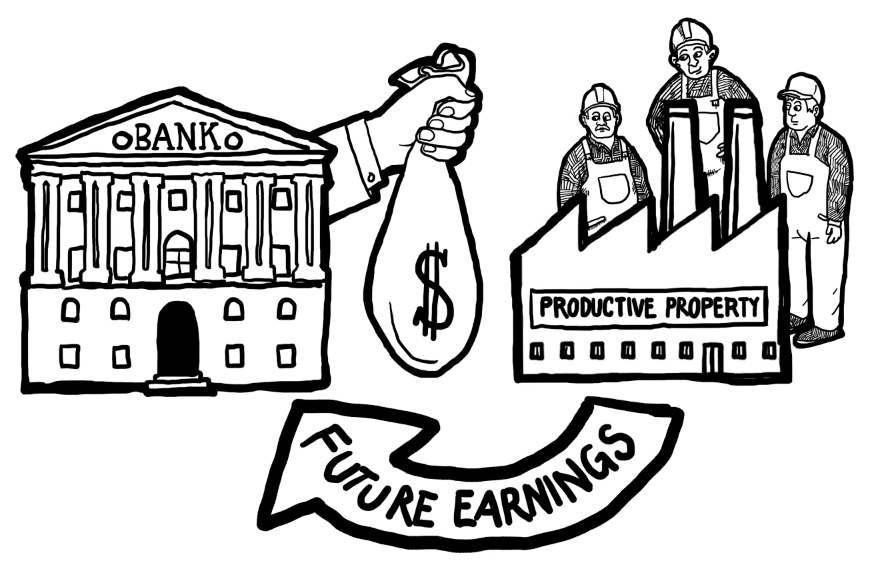
Leveraged ESOPs are generally seen as complex systems but in reality it is more about confusion and not knowing how things work. This short article will give an introduction to the leveraged ESOP as developed by Louis O. Kelso back in 1958.
The leveraged ESOP allows employees to become owners of the company by obtaining shares through the ESOP plan. The shares are bought from a loan that the company takes and not by private funds of the employees. A key point, allowing all employees to become owners of the company they work for – this was an aim of Kelso.
The advantages of the company taking the bank loan for an ESOP are clear:
- The company will get a bank loan more easily in comparison to employees because of the guarantees that the company can give.
- The loan can be paid back by future earnings (for example: dividends).
- All employees are able to participate no matter what their financial background is.
- Employee participation in general provides more employee motivation and allows for a sustainable business succession.
Though, to prevent differences between employees that join at different points in time, holding periods and other rules need to be made.
An interesting article for further reading on employee motivation by the use of ESOPs can be found under: lifehealthpro.com
Do you have an interesting article you want to share with us?
Contact us at: contact.proefp [at] googlemail.com or connect on Twitter via:@ProEFP
Infographic: ESO in Europe
Infographic: ESO in Europe

source: European Company Survey 2009
Do you have an interesting article you want to share with us?
Contact us: contact.proefp [at] googlemail.com or connect on Twitter:@ProEFP
Best Practice: Gore and Associates
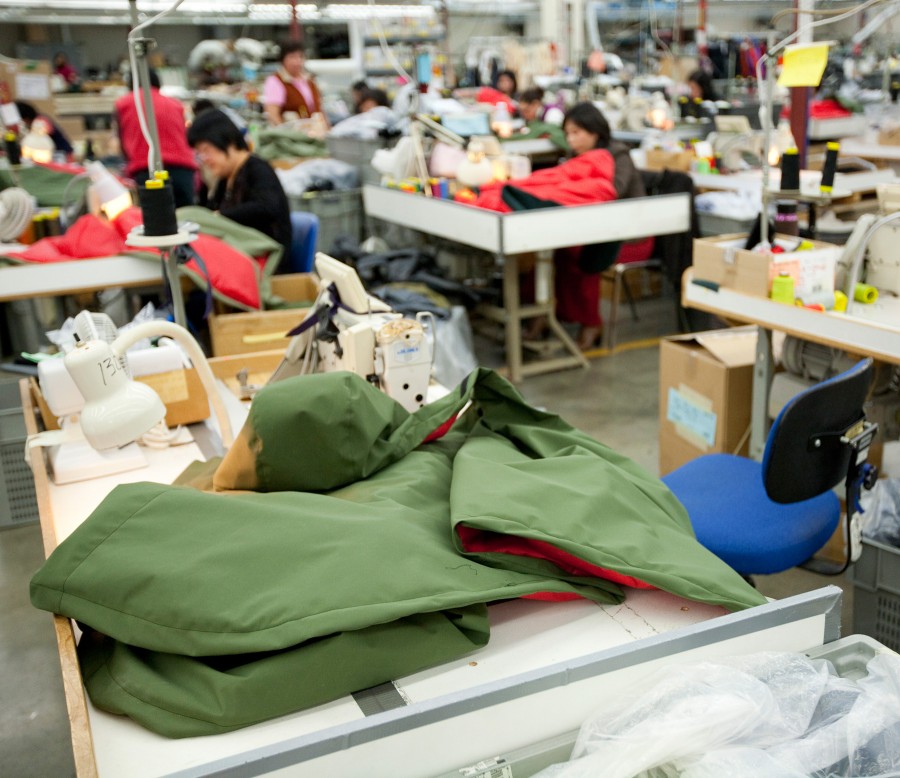
As Gore says themselves: „we have more than 10,000 employees, called associates.“
This, at a first glance, small difference in wording originates from the concept of a latice organizational culture and is in fact having a major impact on the corporate culture and performance of Gore. Every employee at Gore is indeed sharing in the corporate success via the ownership of stocks. A central element, the so-called Associate Stock Ownership Plan, allows the associates to do so. This gives Gore and its associates multiple benefits, among which:
- Opportunities to build up financial security for retirement.
- Improving performance by giving the employees the feeling of being a co-owner of the company that they work for.
Also see Forbes’ Article: Four Ways To Get Your Employees To Care Like Owners http://t.co/kZx0TVg6LZ
It is not without reason that Gore becomes well ranked in various overviews for best companies to work for. Even better, this does not only hold for the US based facilities, but also for most of their worldwide facilities.
Click here to keep reading about Gore as a best practice!
Selected Articles: Why more employee ownership is needed! (from: US News)
We found this interesting US News article on why more employee owned businesses are needed. The article is perfectly describing the similarities and differences between employee and non-employee owned companies.
David Brodwin, the author, points out that: “A truly sustainable economy needs more employee-owned businesses and partnerships.”
He also makes an important point by claiming that: “These businesses stabilize consumer incomes and spending power, stabilize employment, stabilize corporate cash flows, and blunt the extremes of the business cycle. For this to happen we’ll need to find ways to attract more capital into the field, to finance the conversion of existing investor-owned businesses to a new ownership model.”